Showing posts with label University of California. Show all posts

Tuesday, February 28, 2012

Paying for an Education: the University of California, Berkeley

The Campaign for Berkeley sent us alumni a marketing package in hope of obtaining donations.

Yearly tuition and expenses for in-state students living in campus housing is $32,634 (As opposed to the University of California schools, the average annual student budget is $19,700 for a California State University resident undergraduate [Source: Legislative Analyst's Office]).

About 70 percent of students receive financial aid. How could it be any other way, when the average family in California per capita income is around $43,000?

Compare this state of affairs to the cost of a University of California education for me, 1978 to 1982: around $4,000 including campus housing. I paid for my four-year Berkeley undergraduate education easily through savings, summer work, and $5,000 of loans. Why are finances so much more difficult today?

When I was an undergraduate, the state paid 52 percent of UC Berkeley's funding. Today the state pays 10 percent.  The Great Recession, starting in 2008, has crushed the California budget, especially a budget increasingly dependent on capital gains from the very rich. See below.

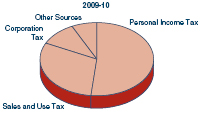
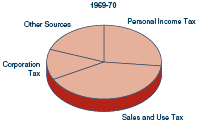
The Composition of Revenues Has Changed Over Time
CF_Budget_09.ai
CF_Budget_09_B.ai
  • Over the past four decades, personal income tax revenues to the General Fund have increased dramatically—rising from 27 percent to 51 percent of General Fund revenues.
  • This growth is due to growth in real incomes, the state’s progressive tax structure, and increased capital gains.
  • The reduced share for the sales tax reflects in part the increase in spending on services, which generally are not taxed. Source: Legislative Analyst's Office (link here)
What to do? See my post (here) on whether California can continue on the same path, taxing itself out of austerity and, perhaps, into prosperity.

Saturday, February 25, 2012

Telegraph Avenue, Berkeley

Berkeley, California inspires me to write. I spent a lot of my youth there and frequently enjoy traversing the Bay to visit. The New York Times can't quite understand the place. See my last blogs about Berkeley here and here.

However, a recent Times article about the decline of (in)famous Telegraph Avenue was more accurate. See it here.

As a late 1970s and early 1980s college student living two blocks away, Telegraph was the location of head shops, tie dye shirts and hippie culture: Berkeley as an anachronism. The street went through a yuppie-ish renaissance in the 1990s and has recently relapsed. Burned shops and vacant lots have precipitated a decline into a wasteland of homelessness, garbage and vermin at Haste Street and Telegraph, a few blocks from the University.

The Times article interviews stakeholders who want to improve the place. A longstanding bookseller in this area "thinks Berkeley should rebrand Telegraph as the place where the Free Speech Movement happened. The city could erect plaques describing the events of the 1950s and ’60s, which would attract tourists and shoppers." I don't care for this idea. Will Berkeley ever outgrow this piece of history?

The Daily Californian reports that the Berkeley city council is looking into the Telegraph problem. The council "will decide whether to pass on a proposal from the Telegraph Livability coalition to the city manager for cost analysis."
Among the [coalition] suggestions aimed at reducing crime is a proposal to establish Walk the Beat, a program that would have UCPD and Berkeley Police Department officers patrol Telegraph on foot. The recommendation also suggests increasing pedestrian lighting at night to create a safer environment for shoppers.
Other recommendations include demarcating street vendor spaces more clearly, creating a “free speech walk of fame” on the Telegraph sidewalk to commemorate the street’s history and increasing foot traffic by expanding public parking and making transit improvements (The Daily Californian, February 22, 2012).
These solutions are only band-aids. How many people will drive to Berkeley to experience the "free speech walk of fame?" Telegraph can't recover until businesses are built on the location of the vacant lots. The Times reports that the City of Berkeley is suing the owner of the vacant lots, so hopefully, the development will start soon. The University should do its part and develop the fallow "People's Park" located nearby, another magnet for filth, crime, and drugs. Get the homeless out of the mud and in shelters, and start the construction for student housing on this prime location tomorrow!

Wednesday, November 23, 2011

Gap Between Rich and Poor Widest in Berkeley

Communism still exists--not in Eastern Europe but in Berkeley, California. Thus I was intrigued when I read the New York Times article, Gap Between Rich and Poor in Area Is Widest in Berkeley.  Instead of planning protests about American foreign policy, maybe the aging Marxists should take a look in the mirror. Alas, I wasn't able to bask in schadenfreude for long. The NYT analysis has two major errors.
Mr. Berube’s research has shown that the area of central Berkeley bounded by University Avenue and Oxford Street [pictured partly in the background of the photo above--MS] has one of the highest concentrations of poverty in the Bay Area, on par with perennially distressed areas like West Oakland and the Bayview Hunters Point neighborhood of San Francisco.
The University of California hosts about 30,000 students, most who live as close to campus as possible, that is, in central Berkeley. (The population of Berkeley is about 100,000.) Most college students live under circumstances of near-poverty, especially Cal's 10,000 graduate students. (As a Cal undergraduate, I survived off an income of less than $5,000 per year.) Mr. Berube is describing much of the student ghetto. I don't think these kids getting PhD's in engineering will be impoverished for long. All cities have chronic poor, those on the way up, and rich people. Berkeley has its poor, but the students shouldn't count as part of the city's Gini (inequality) score.
 Secondly, the reporter writes
Other observers said income inequality persisted in Berkeley because the city’s most progressive policies had been blocked by higher authorities. In 2009, for example, the California Supreme Court let stand a ruling voiding ordinances that require developers to set aside units for low-income residents when they build new apartment complexes.
Huh? Since developers weren't forced to build for low-income residents, fewer poor people were able to live in Berkeley, making incomes more equal, not less. Berkeley's "progressive policies" have nothing to do with income inequality.
But Councilman Kriss Worthington said officials were not giving up in efforts to reduce inequality.
I'm sure the Berkeley government will find ways of poorly combating a non-issue. After all, it is Berkeley.


Teacher by Day, Drummer by Night

Teacher by Day, Drummer by Night
Please recommend this blog to others

Popular Posts